
Kid’s martial arts: How important is having fun? Guest post by Mark McLaughlin
What are some of the reasons why youth athletes drop out of sports?

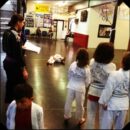
Coach Amanda watches over warm ups in kid’s martial arts class
At least 30 million kids between the ages of 6-17 play in organized sports programs each year and of those 30 million about 35% drop out each year. A more staggering statistic is 70-80% of youth between the ages of 13-15 drop out of organized sports entirely. One of the most widely cited studies on why youth athletes stop playing organized team sports is called “Participation and Attrition Patterns in American Agency-sponsored and Interscholastic Sports.” 8,000 boys and girls from 10 to 18 years of age in 17 US locations completed a survey on their participation in school and non-school sports programs.
In this survey, 2 fun related reasons were found to be dominant in why kids dropped out of playing sports, these were followed by reasons related to time constraints, lack of coaching, and dislike for the pressures involved with playing sports. They found that three changes would likely induce the greatest number of drop-outs to play the sport again: “Practices were more fun”, “Coaches understood players better” and “I could play more”.

Coaches Amanda, Trent, and Mina get the kids warmed up in kid’s martial arts class
What this study shows us is that when kids are young and participating in sports the FUN factor needs to be the number one rule. Too often coaches and parents believe that playing a more competitive and concentrated schedule year around, beginning when kids are young, will produce a successful athlete and this could not be further from the truth. When you look at for example the Canadian Long Term Athletic Development Model (LTAD http://www.canadiansportforlife.ca/learn-about-canadian-sport-life/ltad-stages) there are multiple stages which young athletes need to progress through to allow them to fulfill his/her full athletic potential later on in life. It is during the early stages of this program which children begin to develop basic physical literacy by learning about agility, balance, coordination, and speed (ABCs). These basics will serve them as training in the later years begins to become more specialized. During this time the focus should be on having fun and participating in a wide variety of sports with a minimal focus on competition.
When you look at the alarming rate of injuries suffered by youth athletes (http://resultsperiod1.com/site/injury-statistics-for-youth-sports-in-the-united-states/) annually in the United States something is wrong with the way we are coaching and training not only the athletes but the coaches and volunteers who are working with them. Coaches who work with youth athletes need to understand that they cannot undertake the same training volume and intensity as teenagers or adults. A more concentrated training and competition schedule when kids are young is one of the major factors of injury and burnout.
In a report called “Go Out and Play: Youth Sports in America” from Women’s Sports Foundation (2008) when parents of kids were surveyed about the reasons behind kids completely stopping playing team sports were asked why it happened, the main reason given for both sons and daughters was “no longer fun”.

Fun game of jiu jitsu virus in kid’s martial arts class
To allow the youth athlete the greatest possibility of reaching their full athletic potential later on in life it is imperative that when they are young the joy of sports and having fun should be the number one goal. Allowing the athlete to mature and develop slowly and steadily is also crucial to keep them out of the high incidence of injury and allowing them to develop the building blocks of physical literacy which will give them confidence to excel and enjoy sports for their entire lives.
by Mark McLaughlin of Performance Training Center
Read More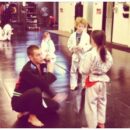
Kid’s martial arts and family
Kid’s martial arts and family

When it comes to martial arts families and kid’s martial arts I often wonder how it gets started. Who is the one that takes the family to the next level? Who are the ones that support the leisure activity that becomes a habit and then becomes a lifestyle? I wish I could speak from experience…I am a novice at best and my daughter has been training longer than I have but not quite a year. What I see where we train is families really trying to support each other in their training. That doesn’t mean that all spouses train but they help drop the kids off, pick them up, attend events, and train themselves. It’s really an impressive feat when you consider the logistics. 
Kid’s martial arts and other activities
When you think of all the different opportunities to be active families have to pinpoint what they want to do and how they can achieve the time and consistency to reap the benefits. It’s the same if it’s kid’s martial arts or piano lessons-we have to make time. I’m certainly of the mind that children should have as much fun as possible. They need to experience a lot of different activities. When family members train or actively participate with kid’s it bonds them. I know it’s helped me in my relationship with my daughter. I’ve seen parents, wives and husbands all take part in each others training at the gym. I’ve seen younger siblings watch their older siblings in the kid’s martial arts class and want to join. I’ve seen the same young children model what is happening in class as they watch their older siblings. It’s fun and it’s cute to see that kind of participation. 
Kid’s martial arts family spotlight
In the coming weeks I will be talking to and interviewing some of the parents and children that train to find out their stories. I will be asking to see how they found out about Brazilian jiu jitsu, if they trained in any other disciplines, and how they got their children in the kid’s martial arts class.
I don’t have too much to offer personally just yet. Over time as I train, my daughter trains, and her younger brother eventually starts to train in kid’s martial arts I may have more stories. However, I can share an actual conversation that took place between my daughter and I one evening after her homework was done and she was going to bed:
Me: Great job with your homework! Now lay down, it’s time to go to sleep.
Daughter: Can I jump on the bed?
Me: No. You can lay down and get ready to go to sleep.
Daughter: (pointing to her 3yo younger brother) Can I do jiu jitsu on him?
Me: (chuckling and trying not to laugh) No. You have to get ready to go to sleep.
Maybe that’s how it starts…

Dad plays before kid’s martial arts class
By Luis T.
Read More
Kid’s martial arts and conditioning
Conditioning and Kid’s martial arts
There are many different thoughts on conditioning for children in all sports, not just kid’s martial arts classes.

Adult coaches watching the kid’s martial arts class, watching the future.
Some parents think that we should start earlier rather than later, others believe that you should start later. Some coaches in youth sports believe you should run kids silly and others believe you should just teach skill. Other coaches think that intense short interval training is best for younger kids rather than longer less intense training.
I recently read an interesting article by a local sports and conditioning trainer, Mark McLaughlin, that really interested me on conditioning for youth. His article was entitled Endurance Training and the Young Athlete. He asks:
Why do athletes believe they need to train so hard all the time? Is it the perception that harder equals better? Or do they believe if they are not working as hard as possible they are not improving? Is this belief an indication of the misguided notions of the coaches and parents who are mentoring these young athletes? Or did the athlete see a video of one of their idol’s workouts on youtube, leading them to mimic that elite athlete’s particular workout (but without understanding how that workout fits into their idol’s monthly or annual workout program, or its place in their idol’s long-term development as an elite athlete)?
This line of questioning was then answered with hard facts when Mark says:
Let’s look at the science involved to better understand how these athletes should be training to properly develop their heart to maximize performance, particularly at young ages.
Kid’s martial arts and what’s best for our kids

Reviewing in kid’s martial arts class
When it comes to kid’s martial arts and any other sport for that there is definitely a trap, at least for parents, to want the best and I know I have fallen into that trap myself. We always want what’s best for our kid’s but sometimes we have to really understand the developmental differences of a young child, an adolescent, and an adult. It doesn’t matter if it’s kid’s martial arts or any other youth sport, I think we all fall into the trap of “working harder is better” when it’s really “working smarter is better.”
I invited Mark to come see one of my daughter’s classes and reached out to him to do a guest blog post. He has many ideas based on actual scientific studies and development in youth athletics and feel his insight would be good for this blog on kid’s martial arts.
Look for it soon…
bu Luis T.
Read More
Kid’s martial arts: Losing is good for you
Kid’s martial arts: participation
I often find articles on youth development and youth sports. I’ve come across one that is very interesting titled: Losing is good for you by Ashley Merryman. It’s a great piece on understanding how kids develop in environments that can be academic or sports related. You may remember her from a previous blog post I wrote Kid’s martial arts and gratitude.
In her Op Ed piece she speaks to the notion of trophies and who receives them. She states in the opening lines:
Whether your kid loves Little League or gymnastics, ask the program organizers this: “Which kids get awards?” If the answer is, “Everybody gets a trophy,” find another program.
Her stance, which makes sense to me, is that sending children the message they can get a trophy for participation is counterproductive to their development and dealing with stress and competition.

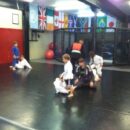
Kids matches in kid’s martial arts class
Kid’s martial arts and problem solving skills
Children are so much smarter than many of us give them credit for and it’s due to there adaptability in situations that can be stressful. To quote from the article again:
By age 4 or 5, children aren’t fooled by all the trophies. They are surprisingly accurate in identifying who excels and who struggles. Those who are outperformed know it and give up, while those who do well feel cheated when they aren’t recognized for their accomplishments. They, too, may give up.
It turns out that, once kids have some proficiency in a task, the excitement and uncertainty of real competition may become the activity’s very appeal.
If children know they will automatically get an award, what is the impetus for improvement? Why bother learning problem-solving skills, when there are never obstacles to begin with?
Teen coach watching over a drill in kid’s martial arts class

One of the reasons we enjoy the gym we go to is that nothing is handed out and that skill is rewarded appropriately. The children in the group understand what’s expected of them and what they need to do to get the next level. That’s not to say they are taskmasters and the children are under constant stress in their kid’s martial arts class but they know what is expected of them.
Kid’s martial arts: don’t spin a loss into a decorated victory
As the founder at SBGi Matt Thornton says often, one cannot fake jiu jitsu anymore than they can fake speaking Spanish or playing guitar. This makes it a great tool for the kids to be able to learn and adapt to in their kid’s martial arts class.

Drilling with a resisting partner in kid’s martial arts class
Read MoreWhen children make mistakes, our job should not be to spin those losses into decorated victories. Instead, our job is to help kids overcome setbacks, to help them see that progress over time is more important than a particular win or loss, and to help them graciously congratulate the child who succeeded when they failed.
Kid’s martial arts: knowing things will get better
Kid’s martial arts: knowing things will get better
With anything new, we start out excited and happy to learn. It’s exciting and there’s a vigor to the learning process-you meet teachers/coaches and students. But how many times have we heard the saying “It’s not how you start; it’s how you finish that matters.” I’ve learned that tempering my own expectations when starting something new has helped propel me over a longer period of time and that consistency is the real challenge for getting good at anything.
I see this in my own daughter as she has grown in her kid’s martial arts class of Brazilian jiu jitsu. We all hit these plateaus where we start to have negative self-talk. I see myself in her when she says things like “I can’t do it,” “I’m too small,” or “I’m not strong enough.” It’s really interesting for me, as a parent, to help coach her through some of these tough times because, given the mere fact that I am older and have experienced it, I know things will get better with fortitude and consistency. I read and hear platitudes in Buddhist teachings to accept the suffering, indeed at times to enjoy and revel in the experience itself. The difference for my 7 year old daughter, and an opportunity for me to help her in her kid’s martial arts class, is she doesn’t know what’s on the other side. She’s only 7 and hasn’t had these experiences. I’ve had them and have difficulty getting through it as an adult at times-we all have had them.
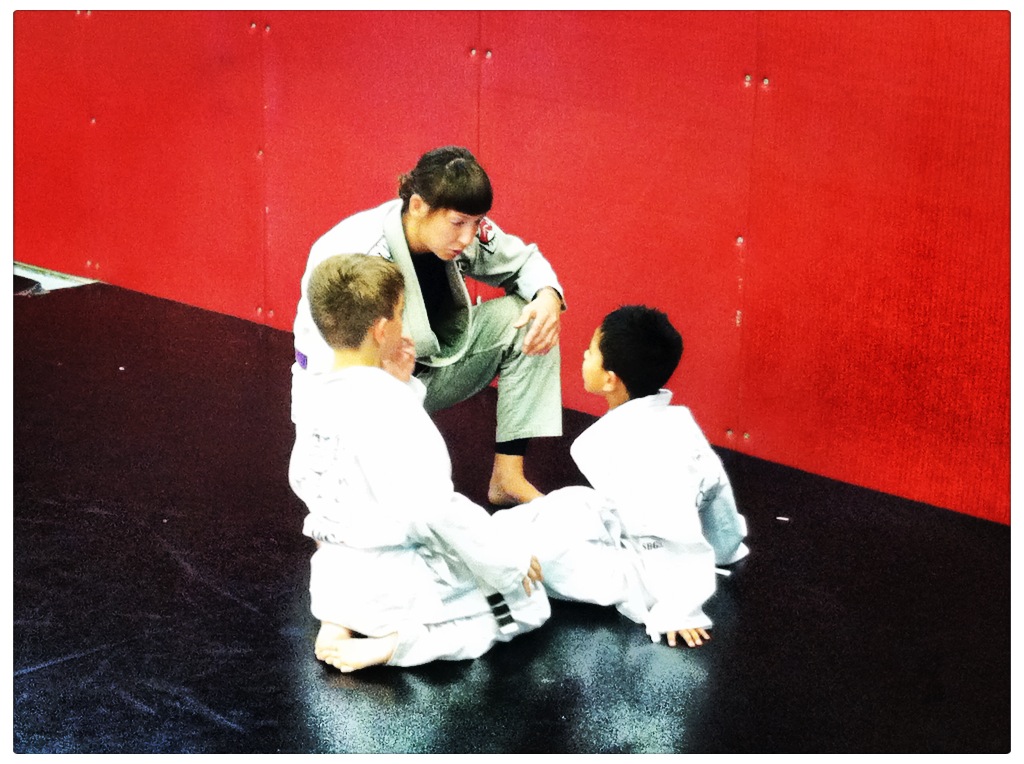
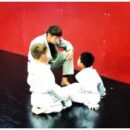
Giving instruction in kid’s martial arts class
Kid’s Martial Arts : it’s a group effort
Adult coaches watching the kid’s martial arts class, watching the future.
Obviously, I work towards and am invested in my daughter doing well, but the great thing about her kid’s martial arts class is that her coaches are also very invested in working with her and helping her through the same tough plateaus. They are that way with all the children in the kid’s martial arts class. They meet the kids where they are because the coaches have been there. They understand the suffocating feeling of being in mount bottom or giving up your back when you didn’t want to-they know the feeling. They help teach the kids that it won’t always be that way; they are models themselves that there is a place beyond the frustration they may, and generally will, experience in a kid’s martial arts class.
Kid’s Martial Arts and life skills
“Instructions for living a life.
Pay attention. Be astonished.
Tell about it.”
-Mary Oliver

Demonstrating in kid’s martial arts class
Such is life. We all feel, love, and learn from our experiences. It doesn’t matter if it’s some frustrating politics in the work place, a three-point shot we can’t seem to hit consistently, or not feeling strong enough in a kid’s martial arts class. We have had those frustrations and we’re all still here, moving forward…
by Luis T.
Read More
Kid’s martial arts, zombies, and Rule #32
Kid’s martial arts, zombies, and rule #32
There are so many reasons in our lives to be grateful. Whether its our families, our jobs, or homes we all have something. Lately, I’ve been watching and reading a lot about the zombie apocalypse. It’s a fairly pervasive theme that we have seen permeate our culture-the idea that the undead would run rampant. I’ve been reading The Disaster Diaries by Sam Sheridan, watching the show The Walking Dead, and also watching zombie movies like Shaun of the Dead and Zombieland.
A favorite treatment of the zombie motif that I enjoy is the movie Zombieland. I like it because there are rules to living in Zombieland by the main character that he attributes to his survival. Rules like Rule #1: Cardio, Rule #2 The double tap, Rule #3 beware of bathrooms, and Rule #4 Seatbelts.
My favorite is Rule #32: enjoy the little things.

kid’s martial arts class in session

What does that have to do with kid’s martial arts?
I’ve learned, as a person and a parent, that enjoying the little things can happen any time, anywhere. It’s simplicity often makes things seemingly intolerable profoundly acceptable. I bring it up in kid’s martial arts because it happens when I take my daughter to class. She has all these mini victories in class, I see coaches who care and who are kind, and I enjoy the company of others at the gym. It’s like the show ‘Cheers’ “where everyone knows your name.” Ironically, Woody Harrelson is also both in Cheers and the movie Zombieland.

kid’s martial arts class, all ages
Enjoying the little things is in the music that is often played at the gym-I’m a big fan of finding new music and bands to listen to but it’s also nostalgic to hear Rick Springfield’s Jesse’s Girl play (takes me straight to grade school!).
It’s a great place where everyone get’s along, the adults watch the kid’s martial arts class as they wait for their class to start and the teens watch also as they wait for their MMA class to start.

Adult class hanging out while kid’s martial arts class is going on…
It really is the little details that you have to enjoy. Maybe some people don’t notice them when they are there, but I can assure you many people notice when they aren’t there.
Rule #32: Enjoy the little things.
by Luis T.
Read More